A personal culinary journal

Palateful Where Culinary Science Meets Food Heritage.

Exploring the stories behind food — from forgotten traditions and regional kitchens to new flavours, techniques and unforgettable meals.

CookResearchExperimentTell a story

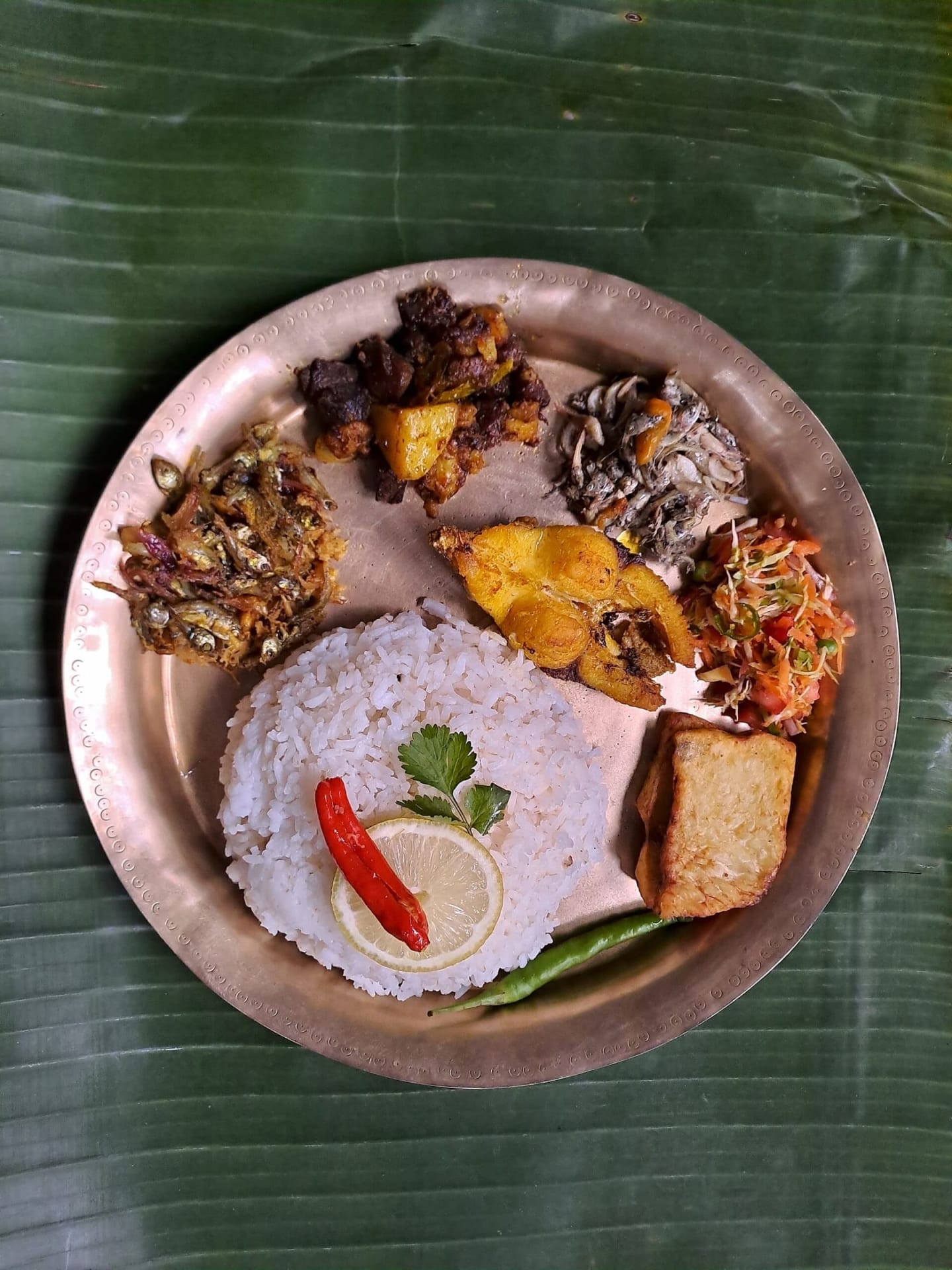
A traditional Assamese thali served on a banana leaf — rice, fried fish, greens, chutney and a wedge of lemon on a brass plate.

A midday thali, served the way it has been for generations — rice at the centre, everything else in orbit.

The featured story

Roots

The Story of Khar

Understanding one of Assam's most distinctive culinary traditions — and exploring how it can be interpreted for the modern kitchen.

Khar is not a spice, not a sauce and not quite a dish. It is an alkali, filtered from the ash of sun-dried banana peel, and it opens an Assamese meal the way an overture opens an opera. This is where the research began.

Read story
The chef behind Palateful, in whites and apron, plating a burger in a professional kitchen.

The person behind Palateful

A cook who kept going home

A Gastronomist. A Storyteller.

My journey with food has always been driven by curiosity — a desire to understand not just how a dish is prepared, but why it tastes the way it does, where it comes from, and the stories it carries.

I am a professionally trained chef from Assam, with a Bachelor of Arts in International Culinary Arts from JIS University, Kolkata. My formal culinary education introduced me to the science, discipline and artistry of professional cooking, giving me a strong foundation in culinary techniques, food science, kitchen management and international cuisines.

My professional journey took me to Vivanta by Taj, Guwahati, where I had the privilege of learning, working and growing alongside some of the finest chefs in Assam. Working in a professional hospitality environment taught me the importance of precision, consistency, creativity and the dedication that goes into creating memorable dining experiences.

But beyond professional kitchens and culinary techniques, there is something that continues to fascinate me: the food of my homeland, Assam. I believe that traditional cuisines are more than collections of recipes. They are reflections of geography, climate, culture, history and generations of accumulated knowledge. From the distinctive chemistry of 'khar' to the delicate sourness of 'masor tenga', Assamese cuisine has an extraordinary culinary vocabulary that deserves to be explored, understood and documented.

That is why I created Palateful. Palateful is my personal culinary journal — a space where professional knowledge meets traditional wisdom, where curiosity leads to experimentation, and where every dish has a story worth telling. Here, I explore recipes, ingredients, culinary techniques, food science and regional food traditions. I research the origins of dishes, experiment with methods, understand the science behind flavours and share what I learn along the way. My approach is simple: Cook. Research. Experiment. Tell a story.

I believe in respecting culinary traditions while remaining open to innovation. I want to document the culinary knowledge that deserves to be preserved, explore the ingredients that make our regional cuisines unique, and make it accessible to anyone who shares my passion for food. For me, cooking is not merely about feeding people. It is about understanding cultures, preserving memories, discovering possibilities and creating experiences. Welcome to Palateful. Let's explore the world of food, one story at a time.

  • AssamWhere the food comes from
  • TrainedProfessional kitchen background
  • HomeWhere the cooking happens now
More about me
Culinary philosophy

Cook. Research. Experiment. Tell a story.

Four movements, always in that order. It is slower than writing recipes, and it is the only way I have found to actually understand a dish.

  1. 01

    Cook

    Before I read a single word about a dish, I cook it the way it was given to me. Badly, usually, the first time. The hands have to know the problem before the head can solve it.

  2. 02

    Research

    Then I go looking — for the older version, the regional variation, the reason the ingredient is there at all. Most traditional cooking is solved engineering. Someone worked it out long before I arrived.

  3. 03

    Experiment

    Only once I understand why a dish works do I have any right to change it. I take it apart, test one variable at a time, and keep notes on the failures — those are the useful ones.

  4. 04

    Tell a story

    A recipe without its context is just a list. I write down where the dish came from, what I got wrong, and what I would do differently. That is the part worth keeping.

Signature techniques

Four methods that define this kitchen

Every regional cuisine has a small number of load-bearing techniques. In Assam, these are the four everything else is built on — and none of them are about spice.

01

Tenga

Layered souring

Sourness in Assam is not one note. Elephant apple, dried thekera, roselle, tomato and Assam lemon each land at a different point on the tongue — and the skill is in choosing which, and when.

02

Khorisa

Controlled fermentation

Young bamboo shoot, shredded and sealed until it turns sharp and faintly sulphurous. Used in drops rather than spoonfuls, it does what a fish sauce does in Southeast Asia — it makes everything taste more like itself.

03

Pitika

Mashing and the raw-oil finish

Boil, mash, and finish with raw mustard oil, onion and chilli. The technique looks like nothing at all, which is exactly why it is unforgiving: there is no cooking left to fix a bad decision.

The culinary journey

How I got here

Five stages, and a great deal of doubling back.

A ferry on the Brahmaputra river in Assam.
  1. 01

    The kitchen I grew up in

    Woodsmoke, a brass pot, and a household where the sour dish and the alkaline dish sat at opposite ends of the same meal for reasons nobody bothered to explain. I ate it for years before I found it interesting.

  2. 02

    Formal training

    Culinary school, and the shock of discovering that everything I had watched at home had a name, a temperature and a reason. Mother sauces, brigade, mise en place. A different grammar for the same language.

  3. 03

    The professional line

    Service. Speed, repetition, consistency, and the particular humility of cooking someone else’s menu very well for a very long time. It is the best technical education there is, and it leaves no room for curiosity.

  4. 04

    Going back

    I started cooking the food of home again, this time with the training. Some of it fell apart under scrutiny. Most of it turned out to be smarter than I was — solved problems I had assumed were superstition.

  5. 05

    Palateful

    A place to do the work properly: cook the dish, research the dish, take it apart, and write down what actually happened. Including the failures. Especially the failures.

Rice cultivation in Assam — flooded paddy fields under a wide sky.

Roots

The tradition first. The interpretation second. Never confused.

There is a habit in food writing of quietly presenting a modernised dish as the authentic one. It flatters the cook and erases the tradition. I would rather do the opposite: set down the original as faithfully as I can, explain why it is built that way, and only then show my own version — clearly labelled as mine.

So every Roots piece runs the same four movements, and you always know which one you are reading.

  1. 01

    Tradition

    The dish as it is actually made, and by whom.

  2. 02

    Understanding

    Why those ingredients, in that order, at that heat.

  3. 03

    Experiment

    One variable at a time, with the failures recorded.

  4. 04

    Reinvention

    My interpretation — offered as an interpretation.